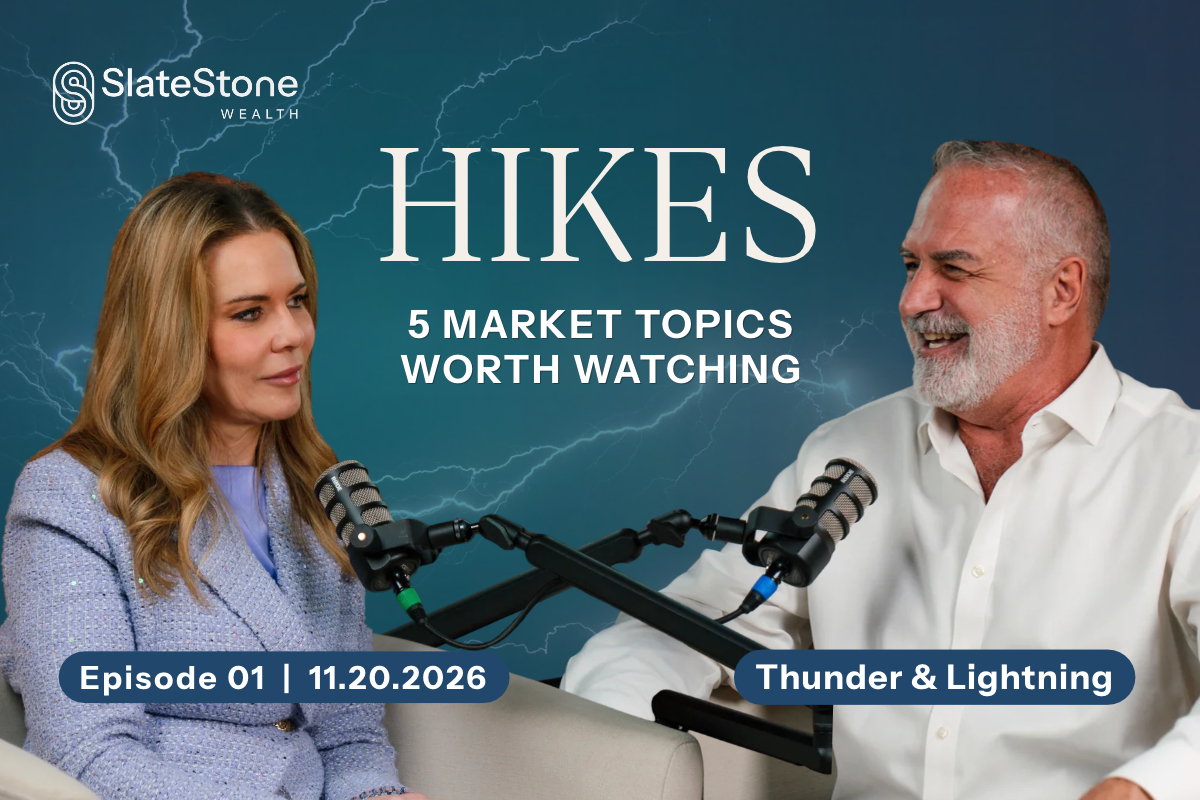
SlateStone Wealth is excited to introduce Thunder & Lightning, a new market commentary podcast featuring Chief Market Strategist Kenny Polcari and Chief Equity Strategist Erin Gibbs.
In their debut episode, Kenny and Erin tackle a packed market agenda, exploring everything from inflation and interest rates to semiconductor stocks, corporate leadership, and the outlook for small-cap companies.
Their starting point? HIKES, an acronym Erin developed to organize five market topics worth watching. And despite the name, they’re not just talking about Federal Reserve rate hikes.
As the conversation unfolds, Kenny and Erin challenge assumptions, compare market expectations, and explore what investors should consider beyond the daily headlines.
H Is for Hot: Inflation, Interest Rates and Housing
Inflation remains central to the market conversation, particularly as investors evaluate what upcoming economic data could mean for Federal Reserve policy.
Kenny and Erin begin by examining inflation readings and the possibility of additional interest rate hikes. They discuss how differences between monthly and annual inflation figures can influence expectations, along with the importance of the Personal Consumption Expenditures (PCE) price index, a key inflation measure followed by the Federal Reserve.
The conversation also turns to Treasury yields and the housing market.
Higher borrowing costs can affect homebuyers, housing activity, and real estate-related businesses. But Kenny cautions against drawing sweeping conclusions from housing data during a seasonally slower period.
The broader question is how persistent inflation and interest rate expectations could affect economic activity and investment decisions.
I Is for It’s Not Just About Nvidia: Looking Beyond the Headlines
Nvidia may dominate conversations about artificial intelligence and semiconductor stocks, but Erin argues that investors should look beyond a single company when evaluating the sector.
She points to the relative performance of semiconductor stocks and raises questions about the growth expectations already reflected in share prices.
Kenny adds another dimension: the distinction between short-term trading activity and long-term investing.
Market reactions to earnings announcements can be influenced by expectations, options activity, and algorithmic trading. Even when a company delivers strong results, its stock price may react differently depending on what investors had already anticipated.
Their discussion highlights an important consideration: a company’s performance and its stock’s performance are not always the same thing.
For investors evaluating technology and semiconductor exposure, understanding valuations, business fundamentals, and market expectations remains essential.
K Is for Key Man Risk: Why Corporate Leadership Matters
A company’s leadership can be an important factor in its investment outlook, particularly when a business is closely associated with a prominent executive.
Kenny and Erin explore key man risk, which arises when a company’s success, strategy, or market perception depends heavily on one individual.
The discussion extends beyond executive leadership to the role of corporate boards.
Effective governance, succession planning, and leadership oversight can help companies navigate uncertainty and maintain continuity when circumstances change.
For investors, the conversation raises a question worth considering: How dependent is a company’s long-term outlook on the people currently leading it?
E Is for Events: Earnings, Consumers and Global Developments
From corporate earnings to geopolitical developments, markets have no shortage of events to monitor.
Erin highlights upcoming earnings reports from major retailers, including Home Depot, Target, and Lowe’s, as potential sources of insight into consumer behavior.
These reports can offer more than a snapshot of individual company performance. They may also reveal how consumers are responding to economic conditions, whether households are prioritizing spending, and how higher borrowing costs influence decisions about home improvement.
Kenny expands the conversation to global developments, particularly geopolitical tensions and their potential influence on energy markets.
They discuss how changes in global oil supply and demand could affect prices, inflation expectations, and broader market sentiment.
The takeaway is that seemingly unrelated developments—from retail earnings to energy supply—can have implications across multiple sectors of the economy.
S Is for Small Caps: The Impact of Oil Prices and Borrowing Costs
Erin makes sure the final letter of HIKES focuses on an area she follows closely: small-cap stocks.
Smaller companies can be particularly sensitive to changes in borrowing costs, interest rates, and economic conditions.
Erin explains how declining oil prices and easing rate expectations could create a more favorable environment for certain small-cap businesses.
Kenny, however, plays devil’s advocate.
What happens if inflation comes in hotter than expected and the Federal Reserve takes a more aggressive approach to interest rates?
That scenario could create additional challenges for companies with significant debt or refinancing needs.
Their exchange underscores why investors should look beyond broad market trends and examine individual company fundamentals.
For small-cap and mid-cap businesses in particular, understanding debt levels, balance sheets, revenue sources, and exposure to changing economic conditions can be especially important.
Beyond HIKES: Do You Know What You Actually Own?
As their conversation comes to a close, Kenny and Erin turn to an issue that can be easy for investors to overlook: overlapping portfolio exposure.
An investor might own shares of Nvidia directly while also holding technology-focused exchange-traded funds (ETFs) and an S&P 500 index fund.
Because those funds may also hold Nvidia, the investor’s total exposure to the company could be greater than expected.
Kenny and Erin emphasize the importance of understanding not only individual investments but also how those investments fit together within a portfolio.
Owning multiple funds or securities doesn’t necessarily mean an investor has the diversification they expect.
Reviewing underlying holdings and portfolio concentration can provide a clearer picture of where investment risks may overlap.
Watch the First Episode of Thunder & Lightning
From inflation and interest rates to technology valuations, corporate governance, and small-cap stocks, Kenny and Erin cover plenty of ground in the debut episode of Thunder & Lightning.
Their different perspectives are part of what makes the conversation interesting. They don’t always approach market developments from the same angle, but both emphasize the importance of understanding the factors behind investment decisions.
And this is just the beginning.
Join us for Episode 1 of Thunder & Lightning: HIKES, and join Kenny Polcari and Erin Gibbs for more conversations about the markets, investment trends, and the questions shaping today’s financial landscape.
Subscribe here for future episodes of Thunder & Lightning.
Disclosure: The information presented in this podcast is provided for general informational and educational purposes only and should not be construed as personalized investment advice or a recommendation or solicitation to buy, sell, or hold any security or investment strategy. The views and opinions expressed are those of the speakers as of the date of recording and are subject to change without notice. Information discussed may be obtained from sources believed to be reliable, but its accuracy or completeness is not guaranteed. Any companies, securities, or investment strategies discussed are provided for illustrative and educational purposes only. Investing involves risk, including the possible loss of principal. Past performance is not indicative of future results.